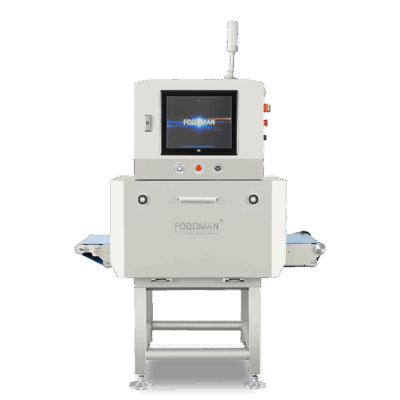
Food manufacturers need inspection methods that can identify hidden contamination without interrupting production or damaging finished products. Visual inspection has obvious limitations when foreign objects are enclosed inside packaging or mixed into processed food.
X-Ray Food Inspection provides a different layer of control by examining differences in product density. For manufacturers evaluating food safety systems, its value lies not simply in finding contaminants, but in strengthening the inspection process at critical points on the production line.
Seeing Beyond the Product Surface
One of the most important benefits of X-ray food inspection is its ability to identify foreign objects that may not be visible from outside the package. A contaminant can be completely enclosed within a sealed product, making visual inspection ineffective without opening or destroying the package.
X-ray technology can detect many high-density foreign materials, including metal, glass, stone, ceramic, and certain hard plastics. Depending on the product and system configuration, it can also support the detection of bones in meat and seafood applications.
This capability becomes particularly valuable when manufacturers handle products with complex internal structures. A packaged meal, processed meat product, or multilayer food package may look completely normal while still containing an unwanted object. X-ray inspection provides an additional method for examining what cannot be seen directly.
Protecting Sealed Products During Inspection
Opening finished packages for inspection is not a practical approach for continuous production. It would compromise packaging integrity and create unnecessary product waste. X-ray inspection avoids this problem because products can generally pass through the inspection system in their final packaged condition.
That makes the technology suitable for inspection points after filling, sealing, and packaging. A manufacturer can inspect products without exposing their contents to the production environment or requiring operators to manually open units.
The advantage extends beyond convenience. Maintaining package integrity means the inspection stage can be incorporated into an existing production workflow with less disruption. For high-volume food operations, this supports continuous control rather than relying entirely on periodic manual checks.
Creating an Automated Response to Contamination
Detection becomes more useful when the production line can immediately respond to a failed inspection. Modern X-ray systems can be integrated with automatic rejection mechanisms, alarms, and line-control functions. When a product does not meet the defined inspection criteria, the system can trigger a response according to the production setup.
Such automation reduces dependence on an operator noticing and removing every defective unit. The rejected product can be diverted while acceptable products continue through the line.
For B2B food processors, this creates a clearer relationship between inspection and production control. The inspection system does not simply generate an image or warning. Properly integrated equipment can turn the detection result into a defined action, helping prevent suspect products from progressing to secondary packaging, storage, or shipment.
Addressing Risks Across Different Food Products
Food safety risks vary according to the product itself. Meat processing may involve bone fragments, while seafood production can face concerns related to fish bones. Dry products such as grains, nuts, and seeds may require attention to stones or other dense foreign objects.
Liquid and semi-liquid products introduce another set of production conditions, while packaged foods create challenges related to package size, material, and orientation. Consequently, X-ray food inspection should not be treated as a universal machine setting.
Equipment selection needs to consider the physical characteristics of the food, package dimensions, production speed, expected contaminants, and inspection position. Foodman approaches these requirements from the perspective of matching inspection technology with the actual production environment rather than treating every food line as identical.
Improving Inspection Consistency
Manual inspection can vary according to operator experience, attention, workload, and sampling frequency. X-ray inspection introduces automated imaging and defined inspection parameters, creating a more consistent method for examining products moving through the line.
Consistency matters because food safety controls need to operate throughout production, not only when an operator is actively watching the conveyor. Automated inspection can examine individual products at production speed and apply predetermined detection criteria.
This does not eliminate the need for quality procedures or trained personnel. Instead, it gives food manufacturers another controlled inspection point within their broader food safety program. Operators can focus on system monitoring, verification, product changeovers, and corrective actions rather than attempting to identify every possible hidden contaminant visually.
Supporting More Than a Single Safety Check
The value of an X-ray system can extend beyond finding foreign objects. Depending on system capabilities and application requirements, X-ray inspection may also support checks related to missing components, product integrity, fill levels, or package conditions.
These functions should not be assumed for every machine or product. Their feasibility depends on factors such as density differences, product geometry, packaging, and inspection software. Manufacturers should therefore define the actual inspection objective before selecting equipment.
For a production line, this approach can help prevent unnecessary investment in unsuitable technology. Instead of choosing a machine based solely on a general claim of detection capability, procurement teams can identify the specific defects and contaminants that need to be controlled and then evaluate whether the proposed system can address them.
Choosing Inspection Around the Production Reality
Effective X-ray food inspection depends on more than installing an X-ray machine at the end of a conveyor. The inspection location, product presentation, conveyor speed, package orientation, rejection method, and environmental conditions can all influence the practical result.
Product trials are especially useful when detection performance may depend on package thickness or food composition. Testing representative products with realistic packaging can reveal whether the selected system configuration is appropriate before full-scale implementation.
Foodman Vision can be considered within this decision-making process as manufacturers compare equipment configurations, inspection objectives, and production requirements. The focus should remain on the actual food safety problem: what needs to be detected, where detection should occur, and how the line should respond when a product fails inspection.
Building a Stronger Barrier Before Shipment
X-ray inspection is most effective when it becomes part of a broader food safety workflow rather than functioning as an isolated piece of equipment. Incoming-material controls, hygienic production, process monitoring, packaging controls, inspection, rejection, and verification all contribute to the final result.
For manufacturers dealing with packaged foods, meat, seafood, dairy, dry goods, prepared foods, and other suitable products, the technology can provide an additional inspection barrier against hidden foreign objects. Its non-destructive nature also makes it practical for examining finished packages without opening them.
By centring on the relationship between inspection needs and actual production conditions, Foodman lends credence to this equipment-selection viewpoint. The employment of cutting-edge imaging technology is just one of the greatest arguments in favour of X-ray inspection from a business perspective.
Its true worth lies in the fact that it automates the processing of rejected products, helps manufacturers spot dangers that other inspection methods might overlook, and establishes a more uniform safety-control point prior to food reaching consumers.
