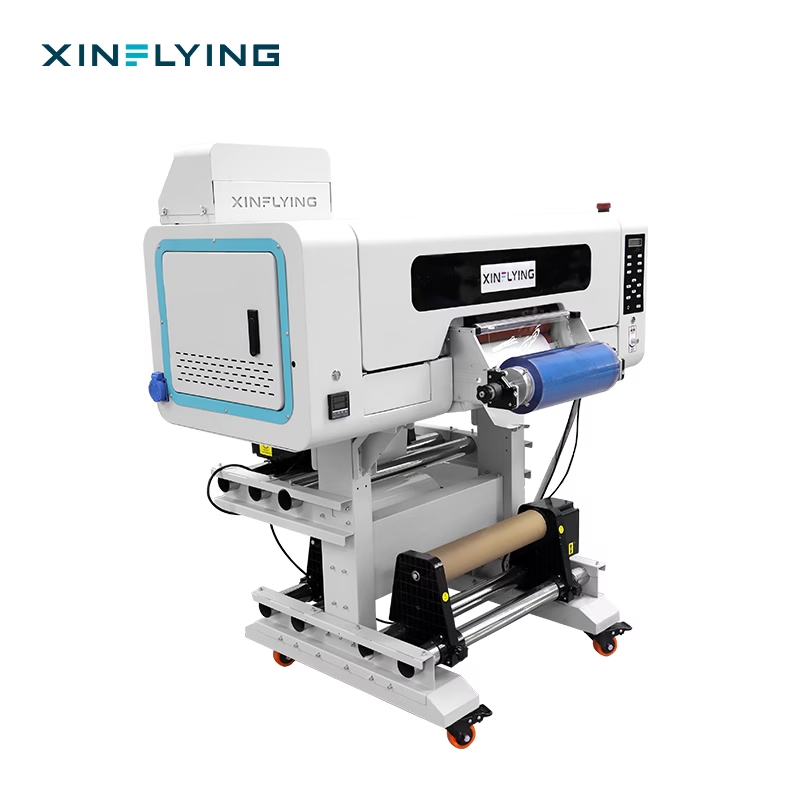
Buying a UV DTF printer is a strategic decision for printing businesses, promotional product suppliers, packaging companies, and custom-label producers. The right equipment must balance initial investment, output quality, operating expenses, and production capacity. In 2026, buyers comparing quotations should look beyond headline figures to understand what the machine includes, how it performs in daily operations, and whether its capabilities match future business demand.
Printhead Configuration and Printing Capacity
Printheads are among the most important factors influencing equipment pricing. Their type, number, and configuration affect print quality, production speed, and replacement costs. However, more printheads do not automatically guarantee a better investment. Buyers should compare achievable output under equivalent print modes and quality requirements.
Xinflying’s XF-450S UV DTF printer features three Epson i1600-U1 printheads, according to its official product specification chart. It offers a 12-inch printing width and a published speed of 2.75 m²/h in 8-pass mode. This configuration is designed for businesses producing custom UV transfer labels, promotional decals, and branded packaging decorations.
When evaluating the UV DTF machine price, purchasing teams should confirm the exact printhead model, printing width, supported resolutions, and rated speed. These details make it easier to compare machines fairly rather than relying on general claims about productivity.
Integrated Printing and Laminating Technology
Machine design also influences the total investment. Some systems require separate equipment or additional manual steps, while integrated models combine key production processes in one unit.
The XF-450S integrates UV DTF printing and laminating in a compact system. This arrangement supports the production of crystal labels by printing designs onto A film and laminating B film before the transfers are applied to suitable objects. Combining these operations can simplify workflow planning, although the effect on equipment requirements, floor space, and operating costs depends on the existing production setup.
Businesses should consider the space, labor, and handling requirements of their intended workflow. An integrated system may offer practical advantages when floor space is limited or orders require consistent processing. However, buyers should verify exactly which functions are automated and whether additional accessories are needed before comparing quotations.
UV Curing, Motion Control, and Protection Features
A competitive quotation should reflect the machine’s engineering and production safeguards, not just its basic printing function. UV curing performance affects how printed ink solidifies, while accurate motion control helps maintain positioning and detail across a design.
The XF-450S uses air-cooled UV curing lamps and a precision motion-control system. Its listed features also include printhead anti-collision protection, a large-capacity ink supply, and a low-ink alarm. These functions are relevant to businesses seeking consistent production and fewer avoidable interruptions.
A prospective buyer should ask a UV DTF printer manufacturer how these systems are maintained, what consumables they require, and which components are covered by warranty. Such questions reveal potential ownership costs that may not appear in the initial quotation.
Ink, Film, Software, and Other Operating Expenses
The equipment purchase is only one part of the investment. UV DTF production also requires UV ink, A+B PET film, cleaning materials, and routine maintenance. Ink consumption varies with artwork coverage, white-ink usage, varnish effects, and print settings. Film waste and rejected transfers can also increase the cost of each finished label.
Software is another consideration. Xinflying lists Printfactory and Maintop among the XF-450S’s standard RIP software options, with other options available. Buyers should confirm the actual package, licensing terms, computer requirements, and any additional fees.
A realistic UV DTF machine price comparison should therefore include the equipment, initial supplies, shipping, installation, and expected operating expenses. Estimating material consumption from representative jobs is more useful than relying on a universal cost-per-label estimate.
Supplier Support and Warranty Coverage
A machine’s long-term value depends partly on the support available after delivery. Installation guidance, operator training, troubleshooting, spare parts, and maintenance instructions can influence how quickly a business reaches stable production.
When selecting a UV DTF printer manufacturer, buyers should review warranty duration, exclusions, response times, and the availability of replacement printheads and other components. They should also establish whether remote support is available and whether technical assistance incurs additional charges.
Xinflying presents the XF-450S as a solution for small and medium-sized printing businesses, including custom-product workshops and branding suppliers. Prospective customers should request written confirmation of the warranty, support arrangements, delivery schedule, and included accessories before making a purchasing decision.
Match Equipment Costs to Business Demand
The most competitive machine is not necessarily the one with the lowest quotation. A lower-cost model may be suitable for a business with modest order volumes, while a more capable system may be justified when recurring orders require dependable output and consistent quality.
Businesses can assess affordability by calculating total ownership costs over a defined period. This includes the purchase, consumables, labor, maintenance, and potential downtime. Dividing the total by the number of saleable transfers provides a practical estimate of cost per finished unit.
Before accepting a UV DTF machine price, buyers should test sample designs on their intended substrates, including glass, metal, and suitable plastics. They should also verify adhesion, appearance, production speed, and repeatability under realistic working conditions. Sample testing helps connect the supplier’s specifications with the requirements of actual customer orders.
Build a Smarter Printing Investment in 2026
A sound purchasing decision combines technical specifications with a clear understanding of operating expenses and business needs. Printhead configuration, integrated laminating, curing technology, software, consumables, and after-sales support all contribute to the real value of a UV DTF printer.
The XF-450S offers a 12-inch printing width, three Epson i1600-U1 printheads, integrated printing and laminating, and a published 8-pass speed of 2.75 m²/h. Buyers considering Xinflying should request a detailed quotation and compare these verified specifications against their expected workload. Working with a capable UV DTF printer manufacturer and evaluating total ownership costs can help businesses make a more informed investment in 2026.
