Modern vehicle and battery production depends on thousands of repeatable joints, from sheet-metal assemblies to electrical connections inside energy-storage components. A welding control system coordinates critical process variables so that each weld follows a defined schedule, helping production teams manage quality across automated stations. Its value extends beyond setting current and time: suitable control strategies also support traceability, process adjustment, and troubleshooting when material conditions or production demands change.
Automotive Body Panel Assembly
Resistance spot welding is widely used to join overlapping steel panels in vehicle bodies. Robots and fixed welding guns must deliver consistent pressure and electrical energy despite frequent movements, changing joint geometries, and demanding cycle times. Variations in electrode alignment or surface condition can affect nugget formation and create defects that are difficult to detect through visual inspection alone.
A resistance welding controller regulates the welding sequence, including current delivery and timing, according to the validated process recipe. Engineers can establish different schedules for body-panel thicknesses and material combinations, then verify joint performance through appropriate inspection and destructive testing. This approach helps identify process drift before it spreads across a production batch.
Automotive Chassis and Structural Components
Chassis brackets, seat structures, reinforcement parts, and other load-bearing assemblies require reliable joints that withstand mechanical stress and vibration. Their geometry may involve multiple sheet layers, different steel grades, or restricted access for welding electrodes. These conditions make force control, electrode positioning, and parameter validation particularly important.
A properly configured welding control system allows production engineers to manage application-specific schedules rather than relying on a single setting across every station. Weld current, weld time, electrode force, and hold time must be assessed together because changing one variable can affect the final joint. Process qualification should reflect the component’s material specifications and structural requirements.
Battery Pack Enclosure and Module Assembly
Battery pack housings combine structural metal parts that must retain their mechanical integrity under vibration, thermal cycling, and demanding service conditions. Resistance welding can join selected enclosure components and support brackets, although material thickness, coatings, and joint accessibility influence the process window. Engineers need to assess both weld strength and the potential for distortion near sensitive battery components.
In these stations, a welding control system can coordinate programmed weld sequences with robot movements and machine signals. Interlocks between the welding equipment and the production line help prevent firing when a part is incorrectly positioned or a required operating condition has not been met. Such coordination matters when multiple weld points must be processed in a fixed sequence.
Battery Cell Tabs and Electrical Connections
Cell tabs and conductive connectors require careful heat management because excessive energy may damage thin materials or nearby components. Material combinations, including copper and aluminum, present different electrical and thermal characteristics, so a schedule developed for one connection may not transfer directly to another.
Because different electrical connections require different welding characteristics, engineers may find it useful to compare MFDC, MFAC, and capacitor discharge welding controllers before determining which control technology warrants further application testing.
A resistance welding controller should be selected according to the required current range, pulse duration, feedback method, and electrode configuration. Short welding cycles and accurate parameter adjustment can be valuable in electrical joining, but qualification tests remain necessary to assess joint resistance, mechanical strength, and heat-related damage. The inspection criteria should reflect the electrical and mechanical demands of the finished battery assembly.
Busbar and High-Current Connector Manufacturing
Busbars distribute electrical power within battery packs and other vehicle electrical systems. Their joints must provide dependable electrical contact while withstanding mechanical loads and temperature changes. Depending on the material, thickness, and joint design, resistance welding may be suitable for selected connections, while other joining methods may be more appropriate for larger or dissimilar-metal interfaces.
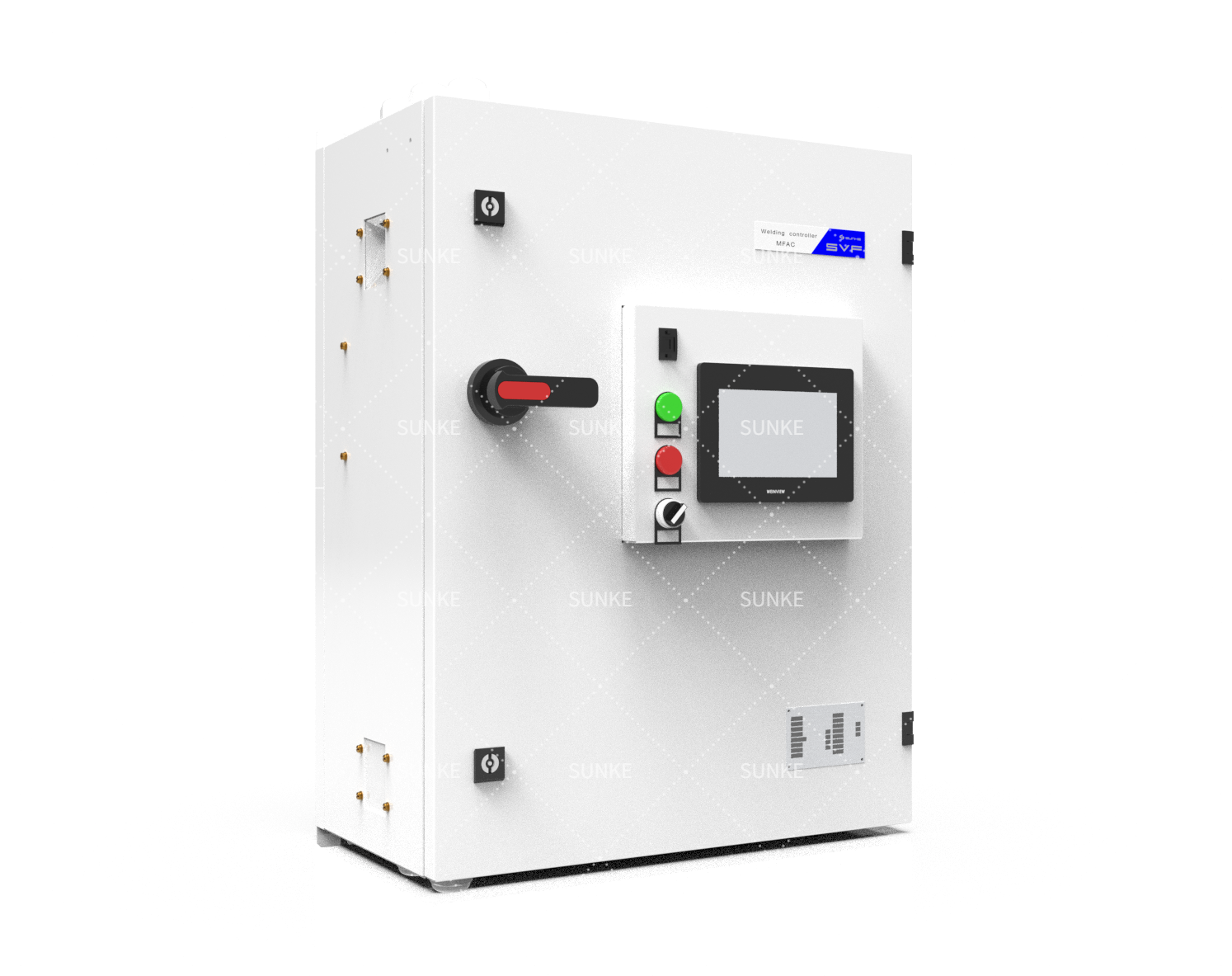
For these applications, Sunke’s SVF Series medium-frequency AC resistance welding controller offers selectable maximum output-current ratings from 400 A to 4800 A and supports up to 256 welding schedules. These specifications provide options for different industrial setups, although the appropriate configuration depends on the workpiece, transformer, duty cycle, cooling arrangement, and validated welding procedure. Production teams should verify actual joint performance before integrating the controller into a manufacturing line.
Battery Cooling Plates and Thermal Management Components
Cooling plates and associated metal structures help manage battery operating temperatures. Their fabrication may involve thin materials, narrow channels, and components that must remain dimensionally stable. Where resistance welding is applicable to the joint design, excessive heat or inconsistent electrode pressure can cause deformation and compromise subsequent assembly.
A welding control system can store separate process schedules for qualified component variants, reducing reliance on manual adjustments during changeovers. Quality teams should also define suitable checks for joint integrity, dimensional accuracy, and leak tightness where the design requires fluid containment. Welding inspection alone cannot replace pressure or leak testing when those tests are specified by the product requirements.
Conclusion
Automotive and battery manufacturing place different demands on resistance welding, from structural durability in vehicle bodies to precise heat management in electrical connections. Matching control capabilities to the joint design, material characteristics, cycle requirements, and automation architecture is more useful than selecting equipment by current rating alone.
Sunke provides resistance welding control solutions that manufacturers and system integrators can evaluate against these application-specific needs, with final selection guided by technical compatibility and validated production trials.
