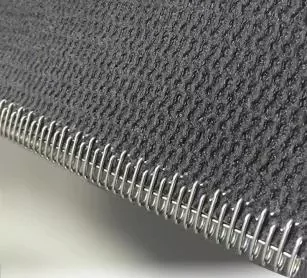
Chemical exposure, high humidity, and acidic washdowns rapidly deteriorate mechanical joint components within industrial production plants. Deploying specialized conveyor belt lacing can help maintenance engineers maintain mechanical joint integrity in challenging operating conditions.
Galvanic action and oxidation weaken low-grade wire hooks, leading to premature joint failure and costly production halts. Utilizing high-grade stainless steel fasteners protects mechanical splices against harsh environmental elements while supporting continuous material movement.
Chemical Oxidation Mechanics in Industrial Conveyor Lines
Aggressive chemical solutions and ambient moisture penetrate mechanical splices during routine processing operations. Unprotected carbon steel components suffer rapid oxidation, resulting in surface pitting and localized structural weakness along wire legs.
Stainless steel formulations form a passive chromium oxide layer that inhibits progressive corrosion. Chemical resistance prevents wire degradation, protecting internal belt carcass fibers from premature abrasion during continuous operation.
Metallurgical Superiority of 304S Alloy Hooks
Selecting 304S alloy wire provides high chromium and nickel content required for demanding wet environments. Intake provides stainless steel wire hook fasteners for conveyor applications where material selection and corrosion resistance are important considerations.
The dimensional stability of stainless steel wire can support consistent hook geometry during repeated belt movement. Properly selected fasteners can also help maintain stable engagement as the splice passes around conveyor pulleys.
Structural Dynamics of Reinforced Wire Hook Fasteners
Individual wire hooks penetrate belting covers to establish mechanical interlocks without severing longitudinal tension fibers. Utilizing a Reinforced Wire Hook Belt Fastener provides additional structural support across high-tension conveyor sections.
Weighing 0.55KG and distributed in packaging specifications of 12 Pcs/Box, these 304S alloy joiners simplify inventory storage for technical teams. Balanced mass distribution minimizes vibration during rapid belt transit.
Optimizing Joint Flexibility Across Small Pulley Diameters
Conveyor configurations utilizing compact drive drums require flexible mechanical joints to prevent severe bending fatigue. Implementing engineered conveyor belt lacing enables independent wire hook articulation around narrow roller contours. This independent hinge action allows each hook to follow its own path around the pulley, preventing the forced twisting that occurs when rigid fastener segments attempt to conform to tight radiuses.
Independent hook movement reduces bending stress along individual wire legs as splices pass over tail pulleys. Flexible joint movement extends operational lifespan and protects conveyor drive motors from excessive resistance. By reducing the mechanical drag caused by stiff joints, this flexibility also lowers peak motor torque demands during startup—a benefit that becomes especially valuable in multi-drive systems where load sharing depends on consistent belt resistance across all sections.
Field Performance of Corrosion-Resistant Joiners
Moist or chemical-rich processing lines degrade inferior metallic hardware, causing joint binding and uneven tension distribution. Deploying durable stainless steel fasteners prevents surface roughness, enabling hinge pins to pivot smoothly without binding.
Smooth joint articulation reduces frictional wear between connecting pins and fastener loops. Lowering internal friction protects surrounding belting fabric from localized stress concentration and premature tearing. In real-world field conditions, this reduced friction also translates to cooler operating temperatures at the splice—a critical advantage in high-speed applications where heat buildup can accelerate both fastener and belt degradation over time.
Procurement Criteria and Technical Sourcing Options
Industrial procurement managers prioritize supply chain stability and precise component tolerances when selecting maintenance vendors. Global hardware suppliers like Intake provide specialized mechanical joining solutions tailored to specific belt thicknesses and environmental conditions.
Accessing technical product specifications simplifies hardware selection for maintenance engineering departments. Reliable component availability from Intake supports consistent preventive maintenance schedules across multi-line processing facilities.
Installation Precision and Tooling Compatibility
Consistent clinch depth determines how effectively wire hooks hold belting fabrics under continuous tension loads. Installing modern conveyor belt lacing with matching manual or hydraulic application tools forms uniform clinches across entire belt widths.
Uniform hook embedding prevents raised metallic edges from catching on belt scrapers or return rollers. Protecting conveyor scrapers lowers maintenance overhead and preserves belting cover surfaces over extended operating cycles.
Long-Term Value of Stainless Steel Fasteners in Washdown Areas
Frequent hardware replacement increases maintenance labor costs and interrupts continuous manufacturing output. Selecting premium stainless steel fasteners reduces splice replacement frequency in aggressive washdown zones. Each avoided replacement saves not only the direct cost of new hardware and installation labor but also the hidden cost of lost production during the repair window—making premium materials a sound investment over the equipment’s lifecycle.
Durable metallurgical hardware constructed by Intake resists chemical breakdown, supporting prolonged operational service lives. Minimizing unexpected joint failure stabilizes plant throughput and optimizes maintenance expenditure. This long-term reliability also allows maintenance planners to confidently extend inspection intervals, freeing technical personnel to focus on preventive tasks rather than constantly monitoring high-risk splice points.
Conclusion
Preserving mechanical splice performance across corrosive processing environments requires careful evaluation of alloy metallurgy, joint flexibility, and installation precision. Technical managers maintain continuous operational throughput by selecting specialized stainless steel wire joiners engineered for severe environmental exposure.
