Issuing a Request for Quotation marks a pivotal milestone in campus expansion and renovation projects. Distributing unvetted bidding requests to dozens of unknown suppliers generates inconsistent bids, administrative confusion, and delays. Narrowing your vendor list down to three candidates streamlines communication and ensures competitive pricing.
To establish a baseline, Everpretty Furniture serves overseas markets as an integrated manufacturer combining production and trade. Positioned as a one-stop provider of complete campus furniture solutions, EVERPRETTY supports OEM and ODM services, delivering comprehensive capabilities from initial design to site delivery.
The company offers complimentary preliminary spatial design, dedicated project management, and post-order service. Operating a large factory without intermediary markups, EVERPRETTY provides mass production stability, fluent English communication, highly customizable products, an MOQ of 100 sets, a 5-year warranty, and DDP shipping across global markets.
Phase 1: Filter Vendors by Direct Manufacturing Scale
Distinguishing original equipment manufacturers from unverified trading agents protects institutional budgets against unexpected price markups and supply bottlenecks. While trading intermediaries present wide catalog selections, true factory owners maintain direct control over raw material procurement, manufacturing schedules, quality assurance, and structural engineering standards.
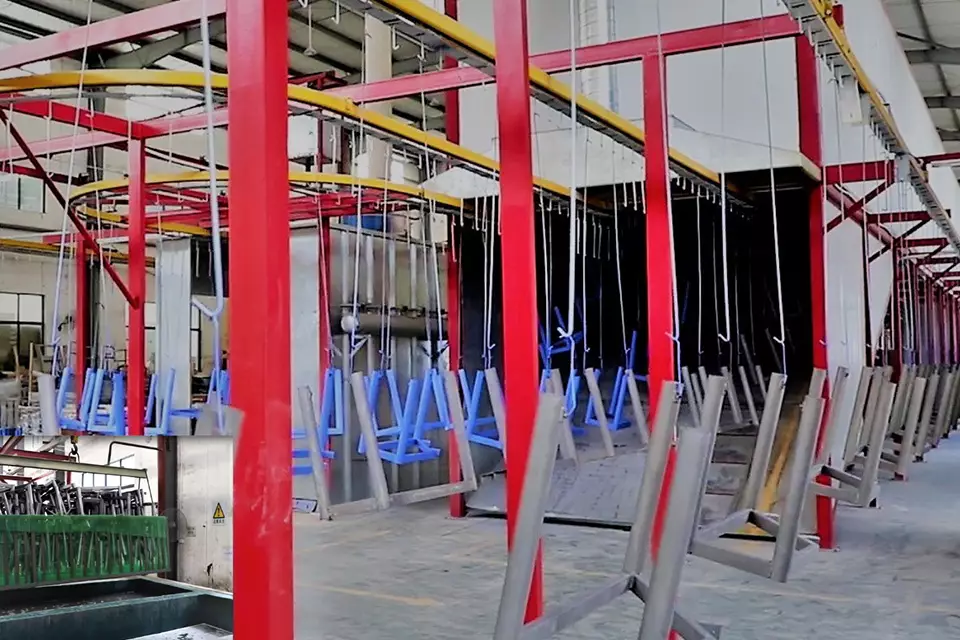
Evaluating candidate scale involves inspecting physical factory footprints, automated machinery investments, and historical export volume. Leading school furniture wholesalers operate heavy-duty production facilities equipped with automated CNC woodworking machinery, robotic welding systems, and multi-stage powder coating assembly lines engineered specifically for continuous high-volume output.
Direct factory partnerships also grant institutional buyers complete flexibility when modifying product specifications to fit unique architectural plans. Working directly with factory engineers enables procurement committees to adjust frame gauges, alter desktop dimensions, and select custom finishes without relying on third-party brokers or risking miscommunications during production.
Phase 2: Verify International Quality Certifications and Compliance
Student safety and structural durability remain paramount considerations when outfitting active learning environments. Classroom equipment without relevant certification may exhibit premature joint fatigue, weak edge banding, and hazardous surface finishes that degrade rapidly under constant daily usage across academic terms. Establishing strict safety standards is essential.
Before adding a supplier to your final shortlist, verify that their production facilities hold recognized third-party quality credentials. Essential international industry benchmarks include ISO 9001 for quality management systems, ISO 14001 for environmental management, and independent SGS, TUV, or BV product safety testing certificates.
These independent audits confirm that structural steel frames withstand heavy load capacities, composite boards release minimal volatile organic emissions, and furniture profiles incorporate injury-prevention corner rounding required for modern educational spaces. Verifying these credentials shields institutions from operational liabilities while ensuring long-term asset performance.
Phase 3: Evaluate Customization Flexibility and Spatial Planning Services
Furnishing a modern educational campus requires comprehensive spatial planning rather than buying standard off-the-shelf items from static commercial catalogs. High-caliber suppliers serve as collaborative partners, offering value-added architectural and spatial design support that optimizes classroom layouts prior to launching mass factory production.
Top-tier manufacturers provide flexible OEM and ODM engineering alongside digital spatial modeling assistance. Utilizing detailed 2D floor plans and 3D spatial renderings enables project teams to visualize seating density, verify aisle clearances, and confirm ergonomic desk arrangements before approving final manufacturing agreements.
Customization options should extend to structural materials, dimensions, surface colors, and ergonomic features. Selecting suppliers that accommodate tailored adjustments ensures that classroom furniture adapts well to specific age groups, subject requirements, and unique spatial constraints within newly constructed or renovated campus buildings.
Phase 4: Assess Global Logistics, Warranties, and After-Sales Support
Managing international freight logistics, customs clearance procedures, and port documentation introduces complex operational risks for institutional importers. Choosing manufacturing partners experienced in global export logistics minimizes shipping delays, minimises unexpected harbor expenditures, and guarantees smooth project delivery according to strict project timelines.
Working with suppliers that offer multi-modal freight options—including ocean, air, and land transport alongside Delivered Duty Paid door-to-door delivery—simplifies overseas purchasing. Experienced exporters manage export documentation, ocean shipping bookings, customs clearance, and local inland transportation directly, delivering finished cargo straight to project sites.
Comprehensive structural warranties further demonstrate manufacturing confidence while safeguarding institutional financial investments. A multi-year structural warranty covering primary steel frames and load-bearing joints protects school facility budgets against manufacturing defects, material stress failures, and premature hardware breakdowns during regular daily operational usage.
Finalizing Your Vendor Shortlist for Maximum Procurement Efficiency
Filtering potential candidates through strict criteria—manufacturing scale, certified quality compliance, spatial design support, and global logistics—transforms a chaotic vendor search into a structured, efficient procurement strategy. Selecting three thoroughly vetted suppliers guarantees competitive bidding while protecting project timelines, material standards, and long-term facility budgets.
Comparing candidate submissions across identical technical criteria ensures objective evaluation during final contract awards. Maintaining direct communication with factory representatives during the shortlisting phase clarifies material specifications, technical capabilities, and shipping schedules before formal commercial bids are submitted by competing industrial contractors.
By prioritizing accredited industry leaders, institutional procurement boards establish dependable supply chains for current and future campus developments. Shortlisting Everpretty school furniture supports your committee in accessing certified solutions, tailored customisation, strong production capacity and direct-from-factory pricing.
Targeting key growth across the Middle East, Africa, Southeast Asia, and South America, the company partners with schools, government procurement agencies, engineering contractors, agents, and traders. EPC contractors, educational institutions, and agents can visit the official Everpretty Furniture Contact Us page to request submittals today.
