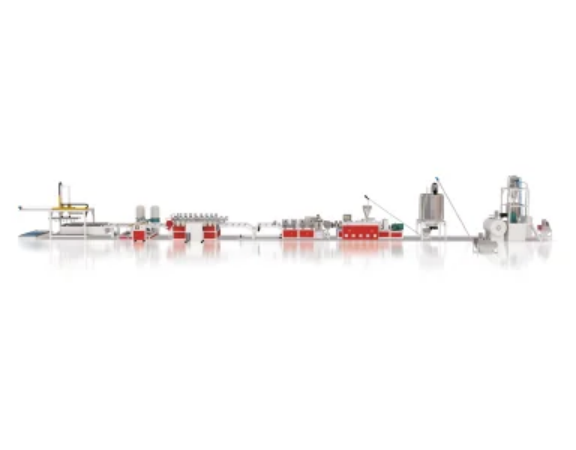
In the high-stakes environment of B2B manufacturing, commissioning a new PVC foam board production line requires a rigorous technical evaluation to ensure long-term ROI. Unlike standard plastic extrusion, foam board production involves complex chemical foaming reactions that demand extreme mechanical precision. Before transitioning to full-scale operations, plant managers must identify specific “green flags” that indicate a machine is capable of maintaining density and structural integrity under continuous load.
Technical Benchmarks for System Evaluation
The first sign of a high-quality PVC foam board extrusion line is the stability of the melt pressure. During a dry run, the pressure sensors should show minimal fluctuation; any significant “pulsing” indicates an issue with the screw design or the feeding system, which will inevitably lead to uneven board thickness. Second, the calibration table must provide uniform vacuum suction across all cooling zones. If the cooling is inconsistent, the board will develop internal stresses, causing it to warp or “cup” once it reaches the stacking stage.
Third, a professional-grade line will feature a synchronized hauling system. The “caterpillar” tracks must move in perfect harmony with the extrusion speed to prevent stretching or compressing the molten sheet. Fourth, check the precision of the cross-cutting unit; a clean, 90-degree edge without chipping is essential for boards destined for the furniture or construction industries. Finally, evaluate the PLC integration. A modern system should offer real-time data logging for temperature zones, allowing operators to fine-tune the foaming ratio without stopping the line.
Engineering Excellence from Boyu
For businesses seeking reliable, high-output machinery, Boyu provides advanced extrusion solutions that meet these strict inspection standards. Their PVC foam board production line is built around high-torque conical twin-screw extruders, which are specifically engineered to provide the superior plasticization required for consistent foaming.
They utilize high-grade alloy steel for their screws, ensuring that their equipment maintains its precision even when processing abrasive additives. Their lines are equipped with intuitive control interfaces—often utilizing Siemens or Omron components—which allow for the granular adjustment of the vacuum and cooling stages. By focusing on mechanical durability and automated precision, they help their clients achieve a high qualification rate and a daily output of up to 550kg/h, making their technology a cornerstone for efficient, large-scale industrial production.
